I currently have 127 different edible crops in production in my 300 square metre subtropical food garden in Brisbane.
My garden had one of the three wettest Mays in 23 years – 223mm fell with a 50 year average of 99mm. This plus extra warm conditions I have for the first time since I started gardening in SE Queensland I have common jute, edible peperomia and cheeky yam (Dioscorea bulbifera) in leaf. Normally these act as seasonal markers, along with Kaempferia galanga, a galangal, becoming dormant. The latter went dormant last week, rather than in late April. Yesterday, I harvested Monastery bamboo shoots, prompted by heavy rain on 28.5.26. It has had such a long and productive season and the shoots have been noticeably sweeter.
First time growers of elephant foot yam (Amorphophallus paeoniifolius) often freak out at the rapidity this crop enters dormancy, they turn yellow and collapse in a few days. Once this occurs they are dormant and you can harvest them. The same applies to winged yam (Dioscorea alata) and African yam (Dioscorea cayenensis), but instead of becoming dormant they remained green. I severed their stems to force dormancy.
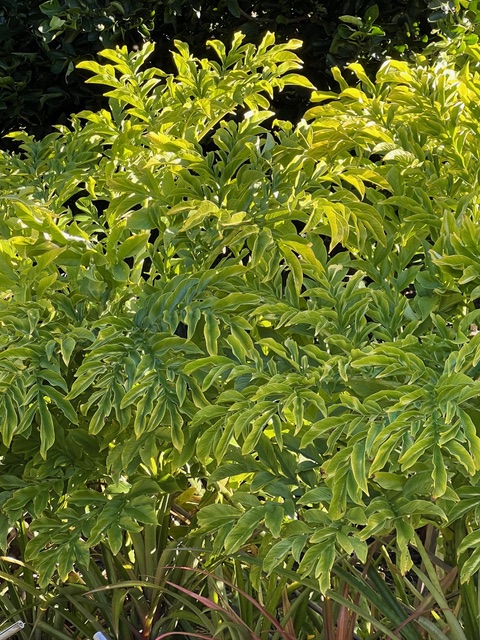
There are a few plants that are fiddly to categorise in a list. For example, we keep two cultivars of sweetpotato specifically for their shoot tips and leaves. But their tubers, though dry, are perfectly edible as wedges or boiled and mashed. Stinking passionfruit are edible fresh and made into jam, but my partner (like his mother) makes green tea with the leaves and shoot tips to get a good night’s sleep. Pigeon pea pods are edible like snowpeas if they are cooked while young and tender, but we prefer to harvest the mature seed since the seed stores excellently well and makes great dal.
As always, I have seedlings in production. There’s kohl rabi ‘Purple Vienna’, our second crop of French bean ‘Cherokee Yellow Wax’ and a batch of snowpea ‘Delta Matilda’ germinating in mini-tubes. These are all protected against rats which have been consistently destructive competitors all year.
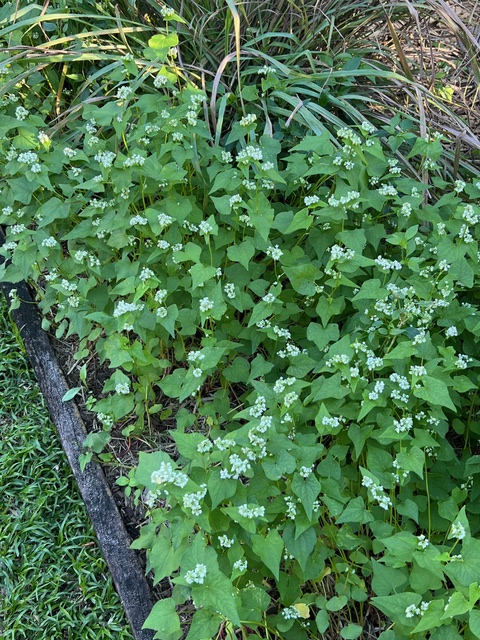
Every food garden needs gap fillers and this year I’m sowing quick growing methi, aka fenugreek (Trigonella foenum-graecum) and allowing purslane, swinecress, Lagos spinach and celtuce to fill up gaps. Due to the warm autumn, there’s a second crop of buckwheat, a short season crop, in full bloom.
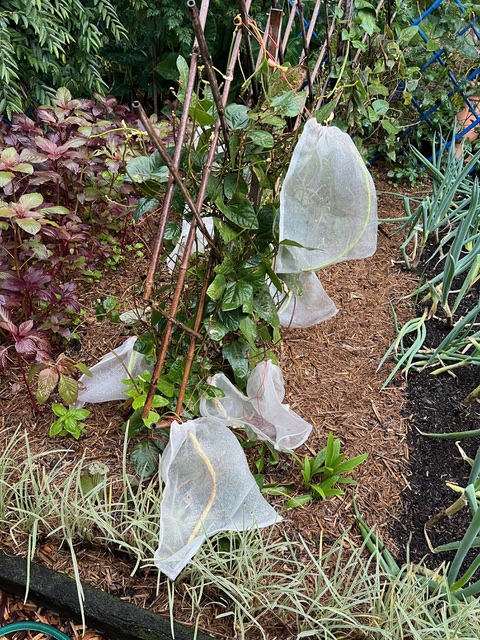
I’ve had an amazingly productive row of locally adapted dwarf snake bean – thirteen years ago I was given their seed by a gardener who had grown them in nearby Cleveland for thirty years. They were sown in October 2025 and removed with their last beans – enclosed in protection bags to slow rat attack – yesterday. The longest productive life of any snake bean I have grown. The beans’ support frame has now been reconfigured to support tall growing snowpea ‘Delta Matilda’.
It’s finally cool enough to sow ‘First Fleet’ lettuce, and that coolness is my prompt to shift the potted pandan and the Anchomanes dalzielii (a famine food from tropical Africa – still in leaf, wow!) into a warm, brightly lit position sheltered from cold winds.
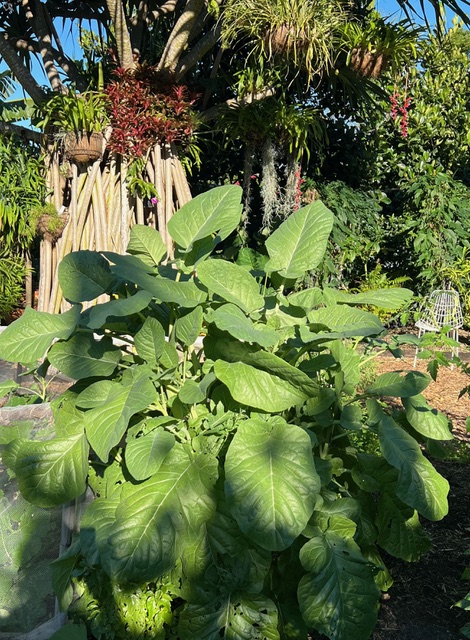
I love old gardening books but I’ve learned to take some of their advice, like sowing times, with a pinch of salt. Our warming climate means that while it’s too warm and winter is too short here to grow a crop of broad bean seed (I still grow them but only for their delicious leaves), warming winter overnight temperatures mean that for the past decade I can sow a crop of corn any month of the year. In 2017, I demonstrated that corn is no longer seasonal in my garden.
The kitchen compost bin is stuffed full of matured compost, ready to dig in. I have continuously improved my soil since 2003, incorporating 4kg of well rotted compost (or manure) per square metre per year. This has steadily increased my soil’s carbon content by 1% a year.
What’s in my Living Larder?
Edible Seed and Pods
Cajanus cajan, Seed Saver pigeon pea
Edible Seed
- Canavalia gladiata, Sword bean (almost ready)
- Coffea arabica First Fleet, Arabica coffee
- Coffea arabica ‘Kamerunga KM36 Dwarf’, Arabica coffee
- Jubaea chilensis, Chilean wine palm
Edible Roots
- Abelmoschus sagittifolius, Native rosella
- Alpinia galanga, Galangal
- Corchorus olitorius, Common jute
Edible Shoots
- Setaria palmifolia cv., Highland pit pit
- Thyrsostachys siamensis, Monastery bamboo
Entire Plant Edible, minus roots
- Ipomoea batatas, Sweetpotato ‘Marguerite’, ‘Ace of Spades’ and two unnamed cultivars
- Peperomia pellucida, Edible peperomia
- Xanthosoma saggitifolium, Cocoyam
Edible Roots/ Tubers
- Beta vulgaris ‘Cylindra’, Beetroot
- Canna indica, Queensland arrowroot
- Curcuma amada, Mango ginger
- Curcuma australasica, Australian turmeric
- Curcuma caesia, Black turmeric
- Curcuma longa, Common turmeric
- Curcuma zanthorrhiza, Temulawak
- Curcuma zedoaria, White turmeric
- Dioscorea bulbifera, Cheeky yam
- Zingiber officinale, Culinary ginger
- Zingiber officinale var. rubrum, Sunti ginger
Edible Stems and Leaves
- Aloe vera – see my recipe
- Colocasia esculentum, Celery stem taro
- Foeniculum vulgare Azoricum Group, Florence fennel
- Lactuca sativa var. augustana, Celtuce aka stem lettuce
- Leucocasia gigantea, formerly Colocasia gigantea, Giant or Indian taro
- Phyllanthus androgynus, Sweetleaf
- Portulaca oleracea, Purslane
Fruit
- Averrhoa carambola, Starfruit
- Benincasa hispida, Giant-fruited Winter melon
- Citrus reticulata x sinensis, Green orange, aka cam sành
- Capsicum annuum ‘Bulls Horn’, Perennial capsicum
- Capsicum annuum ‘Thai Sun’, Chilli
- Capsicum annuum ‘Lieutenant’ (My own cultivar)
- Citrus × latifolia, Tahitian lime
- Citrus x limon ‘Villa Franca Variegata’, Lemon
- Citrus limon x reticulata, Lemonade
- Citrus x limonia, Rangpur
- Citrus hystrix, Kaffir lime
- Citrus reticulata ‘Parramatta Sweets’, Mandarin
- Citrus x sinensis ‘Cara Cara’, Orange (almost)
- Cucurbita moschata ’Butternut’, Pumpkin
- Cucurbita pepo, ‘Black Jack’, Zucchini
- Ficus auriculata, Roxburgh fig aka vả (successive crops)
- Melothria scabra, Mouse melon (plant in its third year)
- Solanum cheesmaniae, Galapagos tomato
- Solanum melongena ‘Listada de Gandia’, Eggplant
Edible Leaves
- Agastache urticifolia ‘Alba’, Korean mint
- Allium ampeloprasum var. porrum, Seed Saver multiplier leek
- Allium fistulosum, Spring onion
- Allium fistulosum, Seed Saver Multiplier onion
- Allium x proliferum, Tree onion
- Allium schoenoprasum, Chives
- Allium tuberosum, Garlic chives
- Alpinia nutans, False cardamom
- Amaranthus tricolor, Ganges amaranth
- Artemisia lactiflora, Jing ju chai
- Bacopa monnieri, Brahmi herb
- Begonia nelumbiifolia, Lotus-leaved Begonia
- Brassica carinata ‘Old Women Meet & Gossip’, Seed Savers Ethiopian cabbage
- Brassica rapa var. nipposinica, Red mizuna
- Brassica rapa var. nipposinica ‘Wynnum Imperial’, mizuna (my own cultivar)
- Celosia argentea, Lagos spinach
- Cnidoscolus aconitifolius, Mexican tree spinach
- Cinnamomum verum, Common cinnamon
- Cryptotaenia japonica, Mitsuba
- Cymbopogon ambiguus, Native lemongrass
- Cymbopogon citratus, West Indian lemongrass
- Cymbopogon flexuosus, East Indian lemongrass
- Cymbopogon procerus, Native lemongrass
- Diplotaxis tenuifolia, Wall rocket
- Eryngium foetidum, Thai coriander
- Fagopyrum esculentum, Buckwheat
- Helichrysum italicum, Curry bush
- Cichorium intybus ‘Green Bowl’ and ‘Salad King’, Radicchio – these two cvs are indistinguishable from each other
- Cosmos caudatus, Kings salad
- Cosmos sulphureus, Yellow cosmos
- Coriandrum sativum, Coriander
- Gynura bicolor, Okinawa spinach
- Hibiscus acetosella, Cranberry hibiscus
- Huauzontle, Chenopodium berlandieri
- Lactuca sativa ‘Darwin’, Lettuce
- Lens culinaris, Lentil
- Lepidium didymum, formerly Coronopus didymus, Swinecress
- Leuenbergeria bleo, formerly Pereskia bleo, Rose cactus
- Marsilea drummondii, Nardoo
- Mentha spicata ‘Nana’, Moroccan mint
- Mentha spicata, Garden mint
- Mentha satureioides, Native mint
- Nasturtium officinale, Watercress
- Nemophila aromatica, Paddy herb
- Ocimum basilicum, sweet basil, Thai basil
- Ocimum hybrids: Hybrid blue basil, Perennial basil
- Ocimum thyrsiflorum, Sacred basil
- Pandanus amarylliifolius, Pandan
- Persicaria odorata, Vietnamese mint
- Petroselenium crispum, Flat leaved parsley and Triple-curled parsley
- Piper auritum, Mexican pepper leaf
- Piper sarmentosum, Lá lốt
- Plectranthus amboinicus ‘Variegatus’ and ‘Bayside Beauty’ (my own cultivar), Four seasons herb aka Mother-of-all-herbs
- Polyscias guilfoylei ‘Variegata’ and five other cultivars, Edible aralia
- Rosmarinus officinalis ‘Benenden Blue’, Dwarf rosemary
- Sedum acre ‘Aureum’, Stonecrop
- Solidago cv., Goldenrod (unnamed sterile hybrid)
- Tagetes lucida, Mexican tarragon
- Talinum fruticosum, Surinam spinach
- Trigonella foenum-graecum, Methi, aka fenugreek
- Tulbaghia simmleri, Giant society garlic
- Tulbaghia violacea ‘John May’s Special’ plus ‘Variegata’
- Vicia faba ‘Aquadulce’, Broad bean
127 taxa
Jerry Coleby-Williams
Director, Seed Savers Network
19th June 2026
 Jerry Coleby-Williams
I’ve just shared it with our Qld contacts.
Regards, Frank Ondrus, Office Manager, HOPE Inc. http://www.hopeaustralia.org.au
Advocating for responsible and sustainable stewardship of the environment
Thanks for this fascinating article Jerry. I am amazed by the range of foods you can grow in Brisbane. We live on a farm in West Gippsland close to Mt Baw Baw so we have a different range of edible plants in our vegetable garden, though there are many you grow that we can grow as well. We experiment with new seeds so I am interested in the crops you mentioned.
We also – along with many of our gardening friends – had an absolute nightmare winter and spring last year with a plague of rats that ate anything they could get their teeth into. The rats weren’t something we had found particularly troublesome in previous years. Summer has been better, but coming into the cold weather we have our fingers crossed for a reasonably rat-free season.
We have our garden fenced and netted to prevent larger birds getting in and eating all our raspberries and tomatoes. The small birds can get in and out and eat the insects. The fence also keeps any marauding rabbits out.
Thanks again for your article.
Cheers from Gippsland