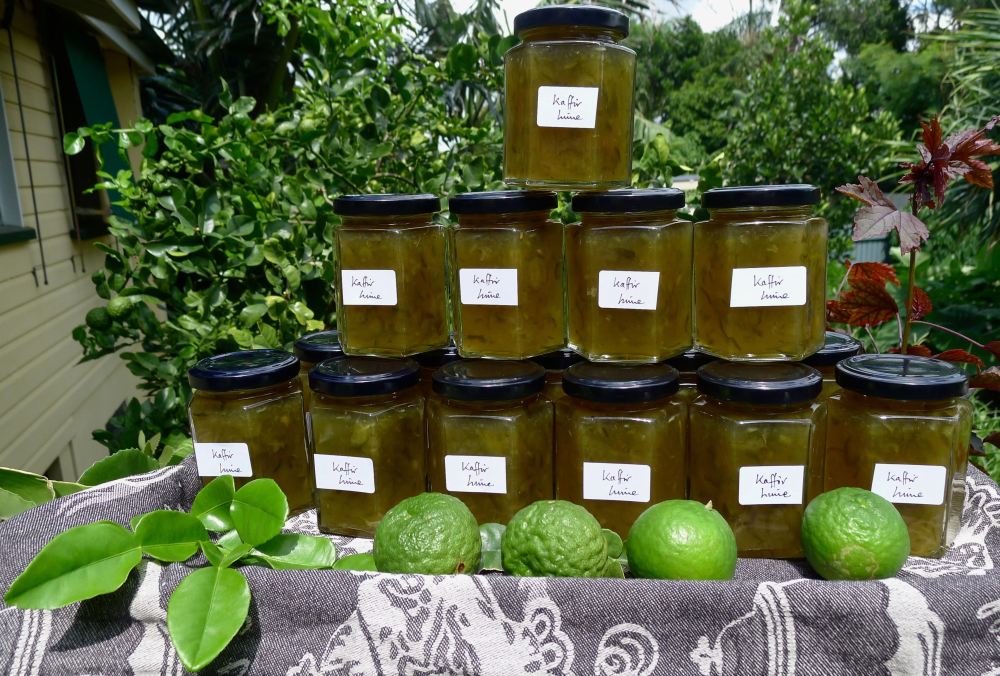
Most people justify growing Kaffir lime (Citrus hystrix) for its aromatic leaves – they add authenticity to Asian salads, stir fries and soups. Did you know the fruit of the Kaffir lime has medicinal applications, or that you can turn it into shampoo? If you’re a novice gardener, there’s also good news about this fruit’s common name. Editors take note: it’s hip and more accurate to call the Kaffir lime by its original name!
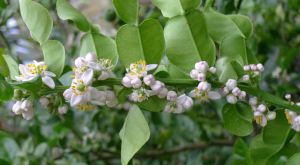
There are many uses for kaffir lime. I use the edible leaves for cookery, juice for drinks like gin and tonic, I grate the rind in cakes and use fruit for making marmalade. The juice can also be used to control head lice, to deter and expel leeches, and the fruit are made into shampoo. That’s pretty versatile, although I haven’t needed to use it against parasites…
Special gear
Kaffir Lime shampoo
The following recipe comes from Michael Commons, Earth Net Foundation, Thailand.
Ingredients
* 1 kg Kaffir limes;
* 1 litre clean water;
Special gear
A section of muslin about the size of a towel, and a heavy based, stainless steel saucepan;
Method
1. Wash fruit, slice into quarters;
2. Remove seed;
3. Add fruit and water to a stainless steel saucepan;
4. Bring to boil, then simmer until fruit are soft, approximately 1.5 to 2 hours;
5. Cool pulp, then squeeze through muslin. This is your shampoo;
6. Use immediately, or
7. To store, re-boil the pulp and bottle it in sterilised glass jars;
Boiling creates a more custard-like fruit pulp, but the cooking time allows you to reduce the water content. By reducing the amount of water you increase the effectiveness of the shampoo, preventing it from separating. The shampoo acts as a combined hair cleaning agent and a hair conditioner.
Kaffir lime – what’s in the name?
Why are people, including cooks, a subtropical gardening magazine, and ABC Television propagating the misconception that there’s anything wrong with the name Kaffir lime (Citrus hystrix)?
English is a complex, nuanced language, and some words have different meanings in different contexts.
The term kaffir (aka kafir or kuffar) has long been historically applied by Muslims to to non-Muslims, it means ‘unbeliever’, a non-Muslim.
Kaffir was then misapplied by Boer and British colonists who once called indigenous South Africans kaffirs.
However, the very earliest written instance of Kaffir lime suggests that the word’s origins have nothing to do with racism in South Africa.
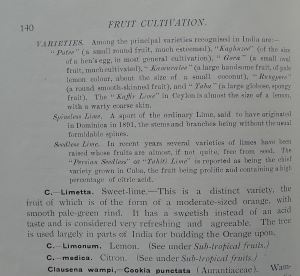
The Oxford English Dictionary points out that Scottish botanist and Kew-trained Curator, H.F. Macmillan, was the first to use the term Kaffir lime in his 1910 ‘Handbook of Tropical Gardening and Planting’.
I have a copy in my library, and Macmillan refers to a lime cultivated in Sri Lanka, the home of an ethnic group that refer to themselves as the Kaffirs. Originally of North African and Middle Eastern descent, they helped Portuguese settlers. Sri Lanka’s Kaffirs now mostly live in an enclave in the Puttalam district and the majority practise Catholicism [Pers. Comm. Sujee Warathnayaka, Sri Lanka, Feb. 2016].
Macmillan lived in Sri Lanka, then Ceylon, for thirty years, and it was there that he wrote his botanical handbook. It is difficult to verify how he, and the other people he heard using the term Kaffir lime, understood the connotation of the word, but it seems at least possible that the name began innocuously and in connection with the Sri Lankan Kaffirs who use Kaffir lime as an edible crop and a medicinal plant. [Pers. Comm. Dr. Achala Attanayake, Deputy Director, Peradeniya Botanic Gardens *].
Given that the earliest evidence of the Kaffir lime’s name comes from Sri Lanka, lexicographer Jesse Sheidlower says, “It seems very likely that it comes from that particular strand.”
By convention, it is expected that any plant is referred to by its most commonly accepted name in the media. Cooks, a certain subtropical gardening magazine, and Australia’s national broadcaster are therefore in error to misapply the name ‘Makrut’ to the Kaffir lime.
Makrut lime is the third most commonly used common name for Citrus hystrix in English speaking countries.
The second most commonly used name is Leech lime. Those who have no interest in science or accuracy dislike like using Leech lime, because they associate it with an unpleasant blood sucking parasite. However, the point of research is to gain a better understanding, and one of the traditional medicinal uses of a Kaffir lime by Sri Lankan Kaffirs is to deter, to rid and to treat wounds caused by leeches. It’s wholly positive.
Sri Lanka’s Kaffirs are proud of their ancestry. I invite you to join me in calling the Kaffir Lime a Kaffir Lime. In so doing you are reclaiming language, an old tradition where persecuted people reclaim the language used to demean them.
An example is where Methodists reclaimed the word ‘methodist’, a word which had been used to put them down for their punctuality. That put down now defines their culture.
The internet certainly gives us cheap and instant access to information, but it doesn’t give us instant wisdom.
The Kaffir Lime is part of the Kaffir language. Sri Lanka’s Kaffir minority ethnic group share this language because they share a history, their share their origins and they share a community… You cannot criminalise the Kaffir people’s history, and the language that emerged from that.
Three cheers for Sri Lanka’s Kaffirs and for those versatile Kaffir limes that bear their name!
Jerry Coleby-Williams
Director, Seed Savers Network
24th March 2016
* ‘Mabberley’s Plant Book’, 3rd Edition, by D. J. Mabberley: “Citrus hystrix DC. (kaffir, leech or makrut lime, Mal.) – ‘lime leaves’ of (esp. Thai) cuisine, effective leech repellent;” Page 191. This work is an internationally accepted, comprehensive, essential reference using taxonomic details using English and vernacular names, for anyone studying, growing or writing about plants: among the most authoritative botanical texts available. Published: Cambridge University Press, 2008;
* ‘Handbook of Tropical Gardening and Planting’, H.F. Macmillan, published by H.W. Cave & Co., Amen Corner, Colombo, Ceylon, 1910; Page 140;
With updates, gratefully received, from:
* M. Ang, Facebook friend, who forwarded information from lexicographer Jesse Sheidlower, 26.9.15;
* Sujee Warathnayaka, Proprietor, Responsible Travel, Sri Lanka, January 2016;
* Dr. Achala Attanayake, Deputy Director, Peradeniya Botanic Gardens, Sri Lanka, January 2016;
 Jerry Coleby-Williams
Thanks Jerry, very interesting to see that so thoroughly considered.
Thank you Jerry. It’s great to be enlightened about plant origins and associated cultures.
Regards
Richard.
Fantastic to get the origin of the name Kaffir Lime. Seems a lot of New Zealanders have certainly got the wrong information.I will continue to use the name Kaffir Lime. Melva 🙂
Happy new year Jerry,
Just a quick question about my Kaffir lime, the fruit never seem to develop large than a 5 cent piece then drop off, they also don’t look very green. I treat it like my Eureka Lemon and that’s going great guns, what am i doing wrong? Help me Obi-Wan Kenobi, your my only hope.
Located in Manly West
A clear sign of inadequate and irregular watering.
Very interesting article, and I’ll never call it anything other than a kaffir lime.
Hi Jerry, when you are slicing the limes for the marmalade recipe, have you removed the membrane that surrounds the flesh before slicing or do you include that in the lime slices? Am looking forward to making some nice tart marmalade so thank you for the recipe.
No.
Thanks for this. I did feel guilty ish by using the original name. Now I don’t.
Thank you Jerry. We made your kaffir marmalade today and it was very successful. We used jamsetta instead of the muslin bag of pips and I added a pinch of salt in case they were too bitter. (I also opted for white sugar). It turned out to be the best jam I have ever made. It set perfectly and it is delicious. It goes great with cheese! Waiting now for the next batch of limes so we can make some more!
Hi Jerry
Made the marmalade yesterday from the limes that dropped from my neighbour’s tree. I usually compost them but found your recipe. Worked a treat. I added three cardamom pods and would add more next time.
Thank you.