What does it mean to be carbon positive? ‘Carbon neutral’ is a state that occurs when net greenhouse gas emissions are equal to zero. ‘Carbon positive’ means going beyond this, making additional ‘positive’ contributions to the environment. How can we achieve a carbon positive lifestyle?
There are three things people can do at a household level, but stopping deforestation is something wider society needs to address…
As an active gardener, planting trees is something I do naturally. Many can be planted native or exotic. All sequester carbon pollution and if they are well placed and suited to their home, they create a living legacy.
Quite a few species also have bacteria living on their bark that digest methane, another greenhouse gas.
Those who attend my talks already know that Melaleuca quinquinervia, aka broad-leaved paperbark, is an incredibly important habitat tree for supporting biodiversity in SE Queensland. I’ve posted and reposted this fact for years to encourage people to grow more.
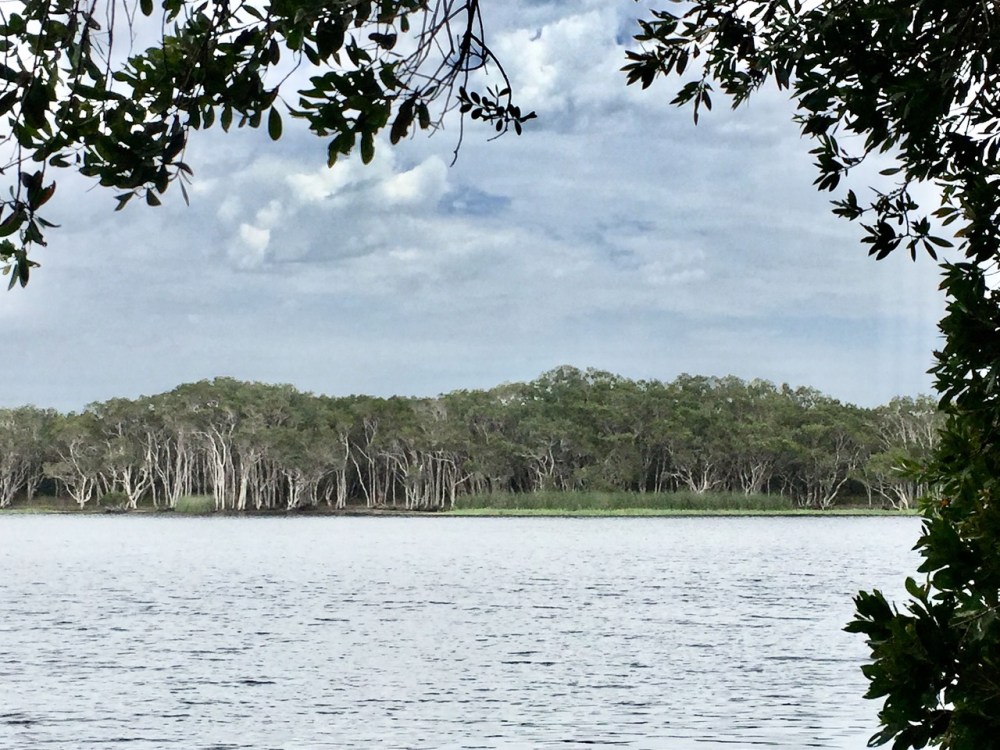
Three years ago, I spoke about the discovery that microbes living within Melaleuca quinquinervia bark were discovered to digest methane gas, a greenhouse pollutant produced in prodigious quantities by fracking and coal mining. Methane is 28 times more potent a greenhouse gas than CO2, the major greenhouse gas.
In the last week, the world hit its hottest ever day so the latest news that the same microbes found in Melaleuca are found in the bark of a wide range of tree species – from England to Amazonia – is all the more fascinating and compelling.
Ending the logging of all native forests is even more important to climate repair than ever.
Carbon Positive Australia says becoming carbon positive may include:
- Halting deforestation;
- Eliminating the use of fossil fuels;
- Sourcing all energy from renewable sources; and/or
- Offsetting more carbon than has been released.
See: ’What is carbon positive?’
I’m often asked how I can live a carbon positive life whilst travelling. The same question has often been asked of environmentalist and former Senator, Bob Brown (mostly by detractors).
My informal carbon budget started with tree planting (London, 1969) which continued until I emigrated in 1992. This expanded once it became possible to purchase 100% renewable energy (Sydney, 2000).
Since 2003, I have been living sustainably. It took my energy supplier three months to draft a one on one evergreen contract for Bellis (my home) to supply solar power to the grid, but exporting energy began early in 2004.
At the time, I went through a process of eliminating electrical appliances to reduce daily needs. Out went the electric toaster, coffee machine, kettle and the water heater (which was here when the house was purchased).
I garden with a solar powered/ battery operated brush cutter, hedge trimmer and lawn mower (rarely used). Plus I have a seventy year old hand propelled lawn mower.
In 2015, an upgrade in solar technology allowed Bellis to have two banks of solar panels which now export three times the daily needs.
Since 2005, I have been growing and selling trees at Open Days. A way to encourage carbon sequestration by others.
I have also planted a small forest of home grown trees on public land around Brisbane. I plant a sapling for each overseas flight. I water these trees during their first year. I know which ones have survived (most) and which haven’t (sprayed with herbicide by council contractors). Two favourite species are Eucalyptus tereticornis and, you guessed it, Melaleuca quinquinervia. I plant these as tubestock. These are the two most important habitat tree species in SE Queensland.
Continuous soil improvement has been a project at Bellis since 2003. See: ‘Productive Garden Development’. In the food garden, I dig in compost (or manure) every time a new crop goes in twice or three times a year. The rate of application is 4kg compost per square metre a year.
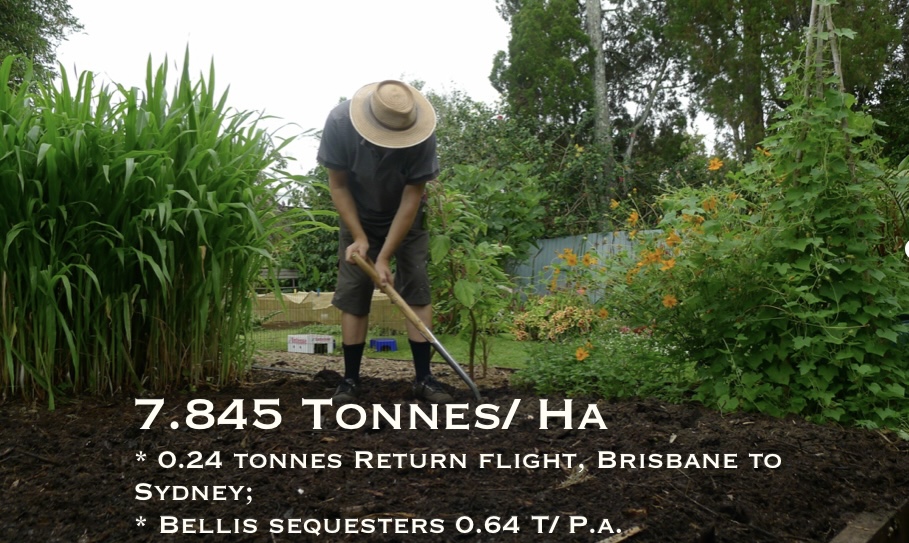
Every spring, I sieve 240kg of compost over my lawn (it helps turf recovery following my Open Days).
In beds where roots prevent digging, like the front garden, I spread a layer of compost or manure and then mulch over that. Just like the lawn, earthworms do the work, eating the organic matter, carrying it into the soil profile where it is sequestered.
My garden soil alone sequesters enough carbon dioxide each year to fly from Brisbane to Sydney almost, but not quite, three times a year.
That amount is more than enough to offset emissions from my car. At tax time you can check for claimable work mileage for your car, but you can also check your odometer for the more accurate annual mileage. In my case travel, which includes filming, speaking and other work, plus shopping runs, is more than offset by soil carbon sequestration.
Christmas: The Festival of Maximum Emissions
One of the more significant personal milestones in living a carbon positive lifestyle came about in 1980 (London). Fed up with people paying lip service to the ‘festive season’ and family rows during that period of joy and good will, I ceased celebrating it. Instead, my inner circle can look forward to a New Year’s greetings card. Every new (gardening) year is worth celebrating…
Think about it: no travel (traffic jams), buying (shopping crowds), posting (will it arrive on time?), cooking heavy food (first everyone moans about the heat during preparation, and then they complain about eating too much!), avoiding alcohol (loose lips and family rows) – a multitude of carbon emissions were set aside on what is now for me a day of calm.
Since that year, friends have had the option of dropping by on Boxing Day for a simple catch up. For those desperate to escape the excesses of the Festival of Maximum Emissions, my home has been a Carbon Positive Sanctuary that won’t cost the planet.
How you can create your own carbon budget?
See:
https://www.ecollectivecarbon.com/blog/how-to-create-a-carbon-budget
Jerry Coleby-Williams
30th July 2024
 Jerry Coleby-Williams
Thanks for the information, and for all you do. John Lee.
Bless!
Thanks for sharing and the great work. Inspired to do more tree planting in this coming yere.