When jaboticaba (Plinia cauliflora) fruit, they do it abundantly. I enjoy eating fresh fruit whole, which takes a little practise.
Jam is a great way to preserve your bounty.
Fresh jaboticaba fruit is rich, mainly in anthocyanins and ellagitannins, which are probably the most important contributors to the health effects associated with the fruit, such as antioxidant, anti-inflammatory, anti-diabetic and hepatoprotective benefits.
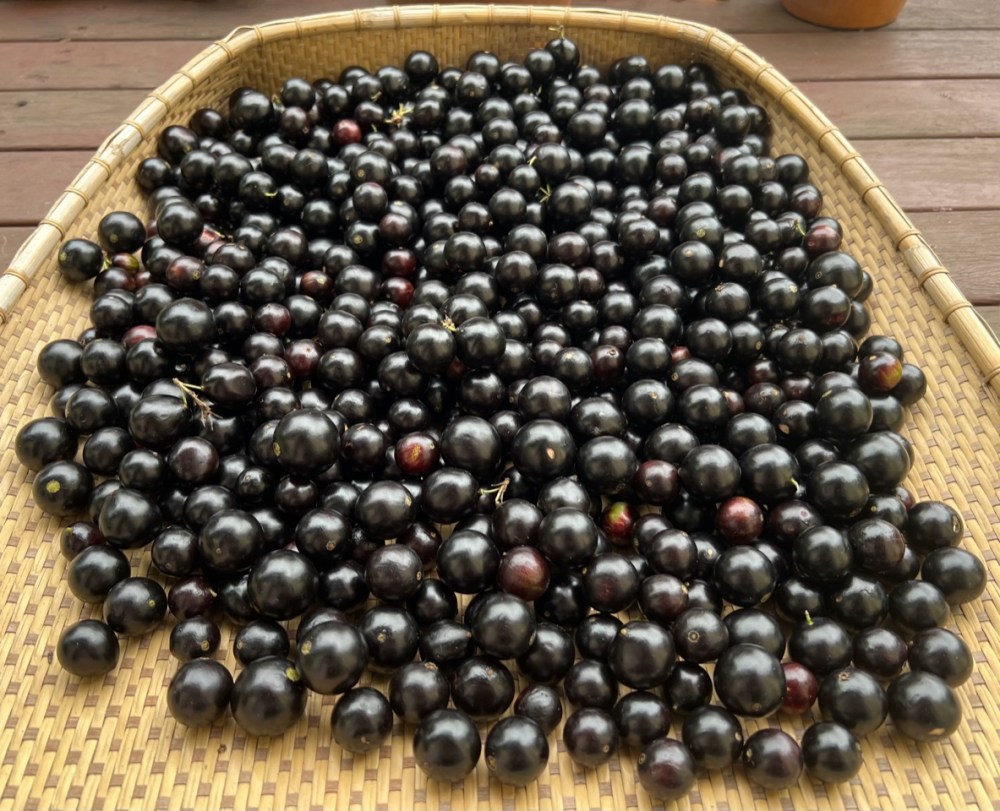
They’re also delicious and are at their best either eaten within a couple of days after picking, otherwise freeze them.
Use the largest fruit for sowing seed. Plants germinate readily from fresh seed and there’s often two or three seed per fruit.
In Australia, Plinia cauliflora succeeds as far south as Wollongong. While they can grow further south, cooler conditions mean a shorter growing season. This is a slow growing tropical tree and can take 7 or more years to fruit in the subtropics. Performance depends on climate and care.
Feed with poultry manure twice in spring, summer and autumn. In dry conditions, water deeply every fortnight from spring to autumn. Do not feed or water in winter.
Plinia cauliflora can fruit three or four times a year. About one bucketful of fruit makes around 6 litres of a deliciously rich and distinctly fruity jam.
Ingredients
Caution: Some recipes suggest adding water. No excess liquid is required. Adding water may result in making cordial, not jam.
- Fresh, washed jaboticaba fruit;
- Sugar;
Method
- Put fruit into a blender. Liquidise for about twenty seconds on the slowest setting;
- Pour liquidised fruit into a saucepan and gradually bring to boiling point, stirring regularly to avoid burning at the base;
- Simmer for thirty minutes to help release pectin and a rich plum purple colour from the fruit. Pectin helps the jam set without adding commercial pectin;
- Take off the heat. Pour contents into a straight-sided colander to drain off much of the liquid. Stir occasionally to assist draining. Drain pulp for about ten minutes;
- Spoon the remaining pulp into a sieve. A sieve made from pressed metal, not woven wire, is more effective at separating juice/ pulp from seeds/ skin. Use a potato masher to press any remaining juices through. Being thorough ensures the maximum amount of jam is made;


The leftovers can be buried. Put it into the compost heap and you’ll have clouds of vinegar flies. Or feed it to pigs or poultry.

- Return sieved, strained pulp to the saucepan and heat;
- Gently bring it to the boil. For each jugful of sieved fruit pulp, stir in a jugful of sugar;
Now is the time to sterilise jam jars and lids for ten minutes. I put jars into the oven on the lowest setting (110C) and I boil lids in water (100C) for ten minutes. Turn off the heat after sterilising to allow lids and jars to cool down before being handled. Timing when to sterilise is important and usually omitted by recipes.
- As the jars and lids are being sterilised, simmer the jam for thirty minutes. Stir to prevent jam sticking or burning at the base. Skim off any scum;
Some recipes say it is possible to spot the jam beginning to thicken. I have never noticed any change – in my experience it remains liquid and runny.
- Turn off the heat;
- Cover jam with a lid and allow it to cool sufficiently for handling, and then
- Bottle it in the sterilised jars.

You may find that almost set jaboticaba jam can be hard to pour into jars, so I bottle it while it is relatively hot and liquid and very easy to pour.
In my subtropical garden, jaboticaba mostly fruit in the warm seasons (my last batch was made on a day of 33.5C) and in such warm weather you may not see the jam set for hours. To preview your success with a batch, especially if it is your first, put a jar in the fridge to see how effectively it has set.
Jerry Coleby-Williams
Director, Seed Savers Network
16th December 2023
 Jerry Coleby-Williams
Thank you for a great article. I think I will buy a tree. I’m in Adelaide, and Daleys have them. The jam sounds lovely. As I write I have a pot of blackberry (from frozen ones) jam on the stove. It’s dismal! So yours sounds wonderful.
Thank you for the recipe. I’ll use a blender next time, certainly will make the job easier. When bottling, I use the cut-off top of a plastic milk bottle as a funnel to fill the jars.
Hello Jerry, I watch you on Gardening Australia – you are the only tropical gardener on the show. ‘
Can you freeze the strained pulp
yes