How can I grow food more successfully and sustainably on a tropical atoll in the Pacific? The high rate of evaporation negates our all year round rainfall. Our ‘soil’ is mostly hungry sand and decomposed coral which is highly alkaline.
Here are some avenues you really need to explore.
1) Crops with multiple uses, such as Pandanus tectorius (fruit and fibre) and Cocos nucifera, aka coconut (food, drink and fibre) are widespread on islands and atolls. They are adapted to these extreme conditions. Pandanus have great roots and their leaf litter are both great for conserving topsoil. If they mesh with fallen palm fronds, leaf litter create conditions enabling colonising grasses, shrubs and vines to grow. These plant communities, however small at first they may be, naturally accumulate leaf litter, and this added carbon fuels the development of biologically active soil. The emerging topsoil will encourage a fine network of roots to spread. Both leaf litter and roots stabilise loose soil allowing a garden to take shape.
Pandanus and palms can be selectively cut to create a raised bed. A space to cultivate plants, like papaya, banana, pumpkin and sweetpotato. A space that provides food security which can be protected from crop pests, like birds.

Ancient Melanesians colonised your region in the South Pacific. They developed their own cultivars of Pandanus tectorius and these ancient ‘canoe plants’ are still around. Traditional knowledge keepers will know of them. One example, is a female Pandanus tectorius cultivar that produces fruit that can be eaten raw (pictured), quite unlike the wild species with fruit that irritates or burns your mouth.
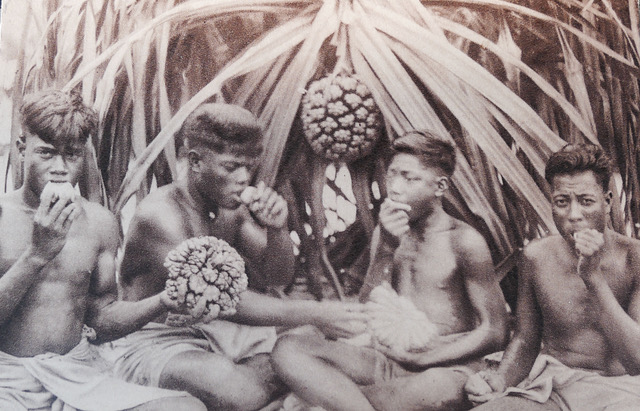
There’s also an ancient male clone with few spines. These served to provide easy to handle leaves for use in weaving and thatching. Both are vegetatively propagated, keeping them true to type.
Coconut, banana, bamboo and sea grape (Coccoloba uvifera) are classical allies for food, fibre, soil improvement and food. Sea grape binds the shoreline and fruits reliably. Trained sea grapes can create shade gardens, their canopy creates dappled shade helping spices, like turmeric and ginger, grow better than in full sun, exposed to drying wind.
Giant swamp taro, Cyrtosperma merkusii, is a traditional Pacific starch staple and leaf vegetable crop well known to tolerate brackish water. Damp spots with brackish water can be dug deeper to create better conditions for this crop.
The book ‘Polynesian Herbal Medicine’ written by my friend and ethnobotanist Dr W. Arthur Whistler, published through the National Tropical Botanical Garden, Hawaii (1992) is an essential reference for the cultivation of food and medicinal crops in the Pacific. A good range are suited to atolls.

2) Soil amendment to counter excessive soil alkalinity is important. Pelletised sulphur lowers soil pH to suit most cultivated crops. You can use powdered sulphur, but it isn’t as easy to apply and work into the soil. Importantly, both acidify soil slowly and over an extended period of up to three years, but more probably two years on an atoll with hungry soil.
The native Beach sheoak, Casuarina equisetifolia, is a valuable commodity. It inhabits your region and is adapted to coastal conditions in warm climates. It has nitrogen fixing roots that bind and stabilise soil, whilst gently releasing nitrogen. Eventually its slow to decompose leaf litter will help to acidify soil pH. Layers upon layers of it leaf litter makes a superb mulch.
In southern Bangladesh beach sheoak is planted in belts to help buffer the low lying coastal communities from storm surges and to protect beaches from erosion as floodwaters drain from land. Coppiced plantings of beach sheoak are cut and bound with wires to create sand stabilising mats used to establish seedling trees . It is a key atoll gardener’s ally.
The greater the proportion of home grown food you eat in your regular diet, the more important it becomes to have the soil tested for nutrient deficiencies. Once you know what they are you can amend them, eliminating guesswork. Achieving a soil pH of between 6.5 and 7 may take time, however, when soil is slightly acidic or neutral, the widest possible range of soil nutrients become chemically available for plants to use. This pH range means you get the best return for using fertiliser.
3) Soil improvement through various methods of compost making. I use eleven techniques at Bellis, my affordable, sustainable house and garden in coastal subtropical Brisbane.
On an atoll you could plant sea almond and Queensland arrowroot for soil improvement. Sea almond, Terminalia catappa, produces nutritious almond-like seed and trees cast good shade from glaring sunshine, the trees drop good amounts of leaf litter which are good for building compost heaps. This orchard tree provides compost, shade and shelter while its roots stabilise the rudimentary atoll soil.
To improve my soil in subtropical Brisbane during the Millennium Drought, I cultivated Canna indica aka Queensland arrowroot for biomass. I have demonstrated that Canna indica requires 1/5th of the water to produce twice the biomass of comfrey (Symphytum x uplandicum). The latter is a favourite soil improver in cool climates, like Northern Europe, and is often incorrectly recommended for warm climates. Beware, comfrey is a liability in a warm climate and useless for an atoll. Bananas, however, are hugely beneficial, offering food, flour, fibre, dye and mulch.
In Brisbane, I still use Canna indica as a cut and come again crop to produce mulch and for compost making. I also grow Cymbopogon flexuosus, aka East Indian lemongrass, a herb, windbreak, source of essential oil and mulch.

Everything deserves a decent burial, especially food waste. By creating Taro pits, a traditional method of soil improvement used in Pacific islands, where a trench is excavated and filled with food scraps, damaged fruit, old bones, fish waste, coconut husks – or fruit infested with fruit fly maggots. Each layer of food waste/ kitchen scraps/ eggshells, etc is covered with a layer of soil. Once filled, cap the pit with a 15cm deep layer of topsoil and plant your taro into this. Surround the bed with logs – cut banana trunks – and mulch with palm fronds. A taro pit can transform soil, eliminate waste and provide a premium crop. Soil texture and fertility rapidly increase.
When Norfolk Island was colonised by Polynesians (between the 13th and 15th centuries) they took useful crop plants with them, like banana. That ancient cultivar is still there. Apart from creating garden beds, banana stems/ logs can create temporary raised mounds for fruit trees and banana leaves make great mulch.
4) Crop protection is helped by using meshes, such as pest exclusion netting and shade cloth. Meshes can exclude birds and pest insects. Mesh enclosures buffer crops from drying winds and hot sunshine.
Drift nets (discarded fishing nets) can be removed from the shoreline and reused to train salt-tolerant vine crops, like velvet bean (Mucuna pruriens), sword bean (Canavalia gladiata), or yellow snake bean (Vigna luteola).
Locating food gardens in the shelter of existing trees or palms takes advantage of the shade protection they offer from hot western afternoon sun. Their shelter also reduces evaporation.
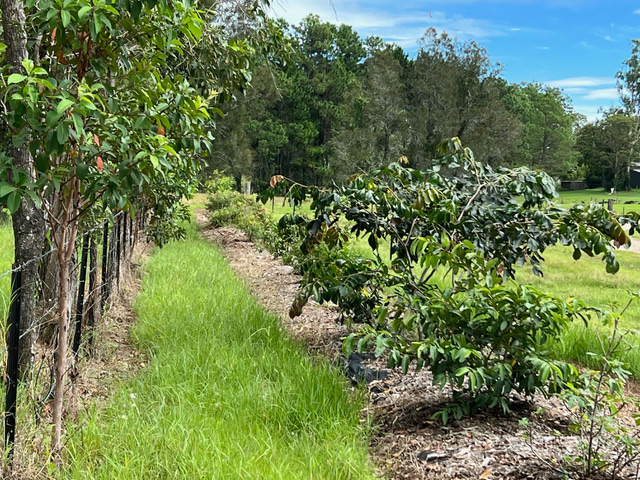
You can’t stop a tidal surge, but you can conserve mangroves wherever they grow, they’re the front line of defence for coastal communities. Salt damage to fruit trees can be further minimised by planting trees and shrubs in ridges or mounds. Vegetable beds should always be raised.
Pictured is a row of various kinds of fruit trees planted in a ridge 1 metre high in coastal Queensland. All the trees were submerged under 3m of flood water for three days. Thanks to the ridge, not a single fruit tree died from suffocation.
5) Growing crops in containers – vegetable pods, self-watering planter boxes, or raised garden beds allow a family (or a community) to grow food intensively in fertile conditions whilst conserving precious water. Use local materials to make containers – gleaned driftwood and pallets are great for construction. Self-watering beds are becoming increasingly important for ensuring an all year round supply of fresh produce with remote island communities.
Try to introduce compost worms into compost heaps. Eventually worms will start living in the topsoil you create. Worms help recycle organic matter and to inoculate the soil with beneficial soil life.
If you can obtain a copy of the Seed Savers Handbook, it will guide you to growing over 100 crops useful for food and medicine, how to keep them vigorous and true to type and how to save their seed. A key source of information.
6) Grey and black water. My subtropical food garden in Brisbane demonstrates it is possible to run a sewage system using solar power and a UV swimming pool filter to sterilise recycled water to boost crops. The Aqua Nova system is produced in Queensland by Everhard Industries, and it has been a popular design used in aid programmes. Processed black water can be used in an endless, continuous loop to operate a flushing toilet and the surplus nutrient-enriched, sterilised water can be used to irrigate and feed crops. This can be vital for food security during drought.
Whether you recycle grey or sewage water for food production, you need to use green cleaners, these are detergents that do not harm soil life or the delicate roots of seedlings. Water containing them is fit for reuse in a garden.
7) Future-proofing traditional crops also involves scientific research. Rising ocean levels and storm surges are infiltrating precious sources of freshwater on islands, so crops which are more tolerant of brackish water (which is also alkaline) have a valuable role to play.
Taro remains a highly valued traditional source of starch and greens in a tropical climate. While there are many, many cultivars, Pacific Islanders are working with Australia to find and distribute salt-tolerant cultivars. The University of Queensland collaboration with Samoa is a great example. Their story on the future-proofing of taro was reported on Gardening Australia,
see: https://www.youtube.com/watch?v=E5bz5EO0od0
Jerry Coleby-Williams
Director, Seed Savers Network
8th September 2025
 Jerry Coleby-Williams
Awesome info 💕